
Mechanical engineering / Mechatronics

Design.
Test.
Integrate.

I’m Asad, a Waterloo mechanical engineering student drawn to the overlap between mechanical design, electronics, and software.

Asad Warind hiking near the Hollywood sign
Asad WarindUsually curious. Occasionally outdoors.
CURRENT INTERNSHIPBattery Test · Harbinger Motors
TEAM LEADERSHIPBattery Mechanical · UW Formula Electric
EDUCATIONWaterloo Mechanical Engineering · 3.9/4.0
01 / Selected work

Engineering in practice.

Projects spanning mechanical design, electrical integration, automation, and software.

01 / MECHANICALDesign in progress

Waterloo Formula Electric · 2027 accumulator

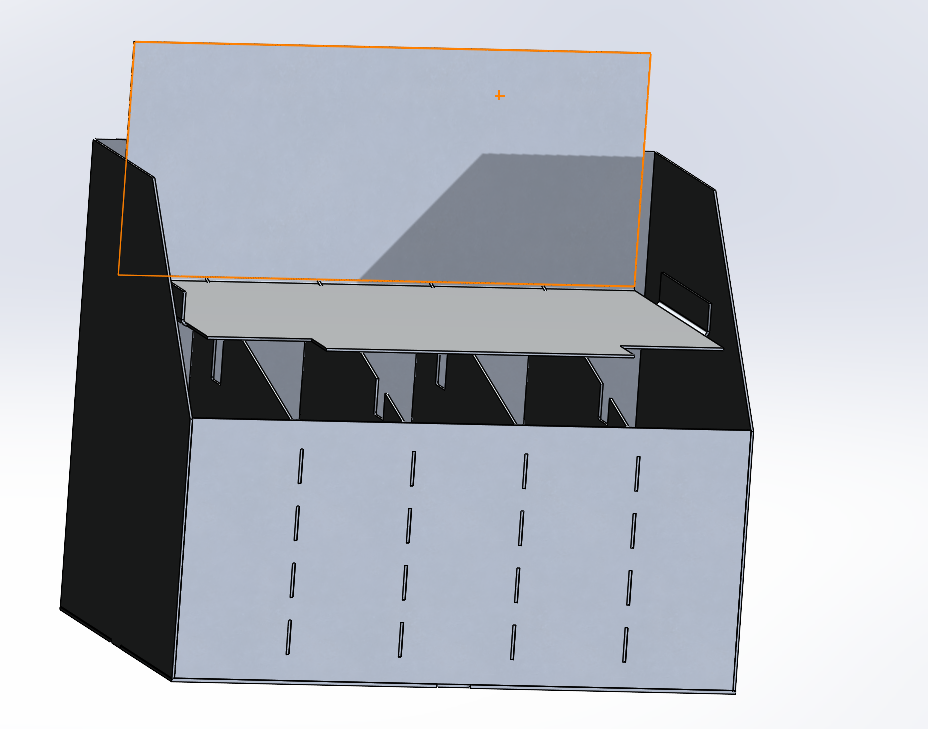
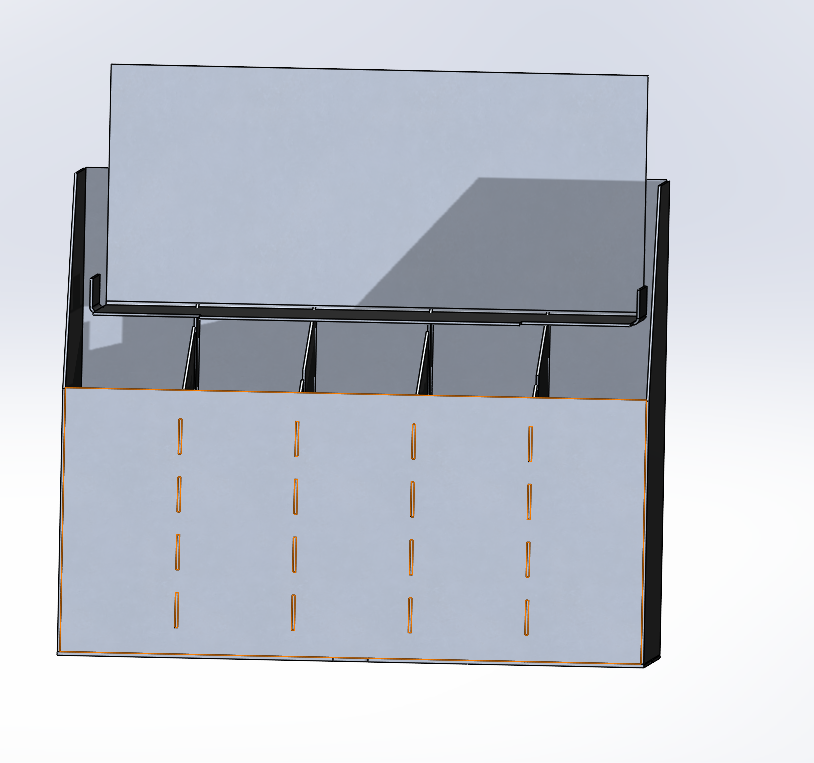
A battery enclosure designed for assembly.

Owning the accumulator-container redesign: sheet-metal packaging, weld analysis, high-voltage isolation, and serviceability for a Formula SAE electric race car.
40 glongitudinal & lateral design loads
SolidWorksSheet metalWeld analysisDFM / DFA
Explore the engineering

The problem

The previous container had many small parts, welding distortion, and tight segment installation. The redesign must satisfy structural and high-voltage requirements while improving assembly and access.

My contribution

Selected 5052-H32 aluminum for weldability and formability. Designed self-locating tab-and-slot features, increased segment clearances, and coordinated insulation, wiring paths, and the electronics shelf. Lead and review supporting work from 5–6 members.

Engineering approach

Hand calculations address wall bending, weld shear, torsional secondary shear, and combined stress under 40 g longitudinal, 40 g lateral, and 20 g vertical load cases. Weld layout balances strength with distortion concerns.

Current stage

Design and hand analysis are active. ANSYS correlation, final mount checks, fabrication, and sealing validation remain to be completed. No final mass reduction or FEA-validated result is claimed.
02 / VALIDATIONAutomation built · test ongoing

Harbinger Motors · Battery test engineering

Automating enclosure durability testing.

Integrated displacement sensing, pneumatic control, and data logging into an existing torsion fixture to execute a prescribed battery-enclosure durability profile.

157,861cycles in the prescribed profile
Arduino C++PneumaticsI²CPython / Pandas
Explore the engineering

The problem

Reproduce torsional bending associated with enclosure-mount failures observed in field testing. The mechanical fixture and pneumatic concept already existed; my ownership was controls, instrumentation, automation, debugging, and preliminary analysis.

My contribution

Implemented stepped pressure control with a rolling-average displacement signal, direction switching, and 10 Hz CSV logging. Integrated pressure sensors, a time-of-flight sensor, regulator control, and solenoid valves across six displacement targets.

Debugging in the real world

Traced a false pressure reading to a loose crimp. Diagnosed switching-related communication freezes as inductive kickback and added flyback suppression. Later isolated frozen analog readings to damaged controller input pins.

Evidence and boundaries

Analyzed approximately 25 hours of unattended data with Pandas and Matplotlib. The prescribed profile totals 157,861 cycles with an intended runtime of about 19 days; these are test requirements, not a claim of final completion. Control is stepped threshold logic, not PID.

03 / INTEGRATIONImplemented on vehicle

Waterloo Formula Electric · Tractive system

Making high-voltage hardware fit.

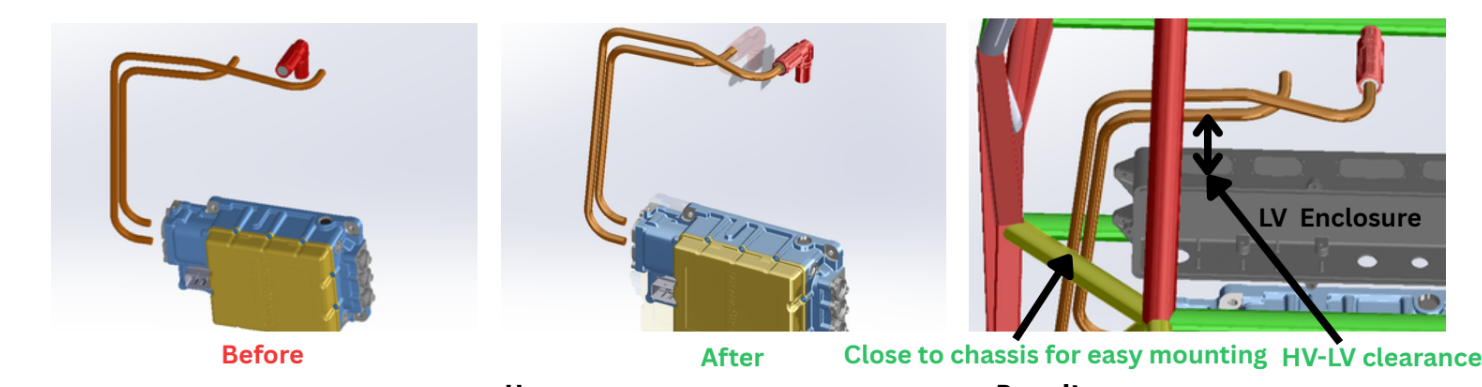
Redesigned high-voltage cable routing in CAD and supported real vehicle integration through harnesses, cooling-fan mounts, and installation tooling.

~20%improvement in HV-to-LV clearance
SolidWorksHV packagingHarness integration3D printing
Explore the engineering

The constraint

Route HV DC cables from the accumulator toward the inverter while respecting available space, bend feasibility, connector locations, access, and separation from low-voltage hardware.

My contribution

Evaluated three routes in SolidWorks using 3D sketches, comparing chassis integration, wiring congestion, motor interference, cable length, and HV–LV clearance. Checked bend radius against the cable datasheet. The selected route was implemented on the car and used during competition.

Supporting hardware

Designed mounts for five accumulator cooling fans using PETG V-0 and a drilling/marking jig for repeatable installation. Also designed electronics adapter mounts under packaging and access constraints.

Result

Approximately 20% greater HV-to-LV clearance in the implemented route. This work connects CAD decisions to assembly, electrical interfaces, and vehicle serviceability.

04 / ROBOTICSBuilt and tested

Course project · Electromechanical actuation

Smoother motion from an RC-controlled rig.

Built an Arduino pan-tilt system with three servos, decoded RC receiver PWM, and improved motion through signal smoothing and travel limits.

~90%reduction in servo jitter
ArduinoPWMServo actuationPower sizing
Explore the engineering

The build

Integrated three MG995 servos with an Arduino and RC joystick control, achieving approximately 120° horizontal and 30° vertical motion.

Controls and integration

Decoded receiver PWM signals, smoothed noisy inputs, and prevented over-rotation. Iterated through physical integration and electromechanical debugging.

Power engineering

Sized the servo power system with hand calculations. Used two 6 V NiMH packs in parallel to meet the servo voltage requirements, with a calculated 48-minute worst-case runtime.

Outcome

Approximately 90% less servo jitter. The runtime is a sizing calculation rather than a measured endurance-test result.

05 / VALIDATIONCompleted

Waterloo Formula Electric · Cell characterization

Characterizing cells for pack assembly.

Performed cell-level resistance testing to support grouping decisions and investigated abnormal cell indications with additional measurements.

300+cells personally DCIR-tested
Keithley 2380DCIR / ACIRExcelBattery testing
Explore the engineering

My contribution

Personally tested more than 300 cells using a Tektronix/Keithley 2380 DC electronic load and recorded measurements in Excel for cell grouping. The broader team tested approximately 600 cells.

Failure investigation

Used ACIR measurements to investigate cells or groups flagged as abnormal by the accumulator monitoring system. Measurements did not indicate unusually high internal resistance, helping rule out one suspected damage mechanism.

System context

The Formula Electric accumulator architecture uses 420 cylindrical cells in a 140s3p configuration, split into five segments. Cell testing and integration support this high-voltage system.

06 / SOFTWAREDelivered

Novika · Engineering internship

Turning product ideas into working software.

Built full-stack features for an interior-design platform, connecting React and TypeScript interfaces with Supabase data and incorporating user feedback through rapid development cycles.

30+full-stack features delivered
ReactTypeScriptSQLSupabase
Explore the engineering

My contribution

Programmed more than 30 full-stack features, extending user-interaction coverage by approximately 40%. Worked across interface behavior, backend data, and product debugging.

Iteration

Investigated UI and backend issues, incorporated user feedback, and adapted features as product requirements evolved during the startup internship.

Data and performance

Restructured Supabase SQL queries and backend data storage, improving platform responsiveness by approximately 20%.

What I took forward

Experience connecting interfaces to system behavior, reasoning about data, and debugging across layers—skills I also use when writing test automation and integrating electromechanical systems.

02 / Experience

Across disciplines.
Through experience.

Harbinger Motors

Battery Test Engineering Intern · Garden Grove, CA

Battery durability automation, high-voltage isolation diagnostics, instrumentation, and preliminary data analysis. Ongoing work includes coolant-system pressure validation.

Waterloo Formula Electric

Battery Mechanical Lead / Tractive System

Progressed from general member to responsible engineer for the accumulator container and mechanical lead of the battery system. Own container design and review work across a team of 5–6 members.

Novika

Engineering Intern · Waterloo, ON

Delivered 30+ full-stack features and improved platform responsiveness by approximately 20%. Built with React, TypeScript, and Supabase, with direct experience in product development, data, and debugging.

03 / Technical foundation

Interested in
how it all connects.

01 — Mechanical

Design & analysis

Mechanisms, sheet-metal design, packaging, DFM/DFA, drawings, and structural calculations. Designing around real assembly and system constraints.

02 — Electrical & embedded

Sensing & actuation

Arduino C++, I²C, PWM, servos, pneumatics, sensor integration, harnesses, and electrical troubleshooting. Connecting physical systems with control logic.

03 — Software & data

Programming & automation

Python data analysis, test automation, and full-stack development with React, TypeScript, SQL, and Supabase. Turning measurements and requirements into useful behavior.

04 / Software & tools

Tools I’m familiar with.

Across CAD, analysis, embedded development, and software.

CAD & engineering analysis

  • SolidWorks
  • AutoCAD
  • ANSYS
  • MATLAB

Mechanical design, drawings, calculations, and analysis.

Test & embedded development

  • Arduino IDE
  • LabVIEW
  • Altium Designer
  • Logger Pro

Test integration and data acquisition. Altium experience focuses on schematic reading and pin tracing.

Programming & data

  • Python
  • Pandas
  • Matplotlib
  • C++
  • Excel
  • TensorFlow

Data processing, modeling, and embedded code. TensorFlow experience comes from coursework and projects.

Web & development tools

  • React
  • TypeScript
  • SQL
  • Supabase
  • Git

Full-stack features, database queries, debugging, and version control.

05 / About

Curious about
the whole system.

I’m studying Honours Mechanical Engineering at the University of Waterloo, with a strong interest in mechatronics. I’m drawn to the space between disciplines: how a mechanism, an electrical interface, and a piece of code come together to make a system work.

That curiosity has taken me from Formula Electric design and battery-test automation to servo control and full-stack software. I enjoy working through the details, whether that means checking a fit, tracing a signal, analyzing a dataset, or debugging an interface.

Outside engineering, I’m into running, soccer, cooking, automotive reviews, and finding a good place to hike.

University of WaterlooB.A.Sc. Honours Mechanical Engineering, Co-op
3.9 / 4.0
06 / Resume & portfolio

A closer look.

My resume and project portfolio, ready to view or download.

What I’m looking for · Four-month co-op

Summer 2027. Let’s build something.

I’m looking for an internship where I can help design, build, and test a physical product or system that brings together mechanical design and electrical systems. I want to work across those disciplines and see how my decisions translate into something tangible.

I’m especially interested in mechatronics, robotics, batteries, energy storage systems, power electronics, embedded systems, and automation, with hands-on work that connects design, integration, and testing.

awarind@uwaterloo.ca